A retail space is not a backdrop for product. It is the most complete expression of a brand's world that a customer ever enters. The floor plan, the lighting, the surface materials, the music tempo, the scent — each element is a design decision that either reinforces or contradicts the brand's promise.
- What feeling should the customer carry from the moment they step in to the moment they leave?
- How does the physical space translate the same narrative that campaigns and catalogues communicate?
- Where in the journey does the brand make its strongest statement — entry, product display, fitting room, checkout?
The best fashion retail environments function as edited spaces. They remove friction and distraction, so that the relationship between customer and product becomes the only story. Luxury especially cannot afford clutter — visual or experiential.
- Anchor the spatial concept in the brand's existing visual identity before any architectural planning begins.
- Define the customer journey as a sequence of emotional beats, not a floor plan of product categories.
- Choose materials that communicate brand values through texture, weight, and temperature — not just appearance.
- Design for the product's scale and personality: a fine jewellery brand and a technical outerwear brand require fundamentally different spatial logic.
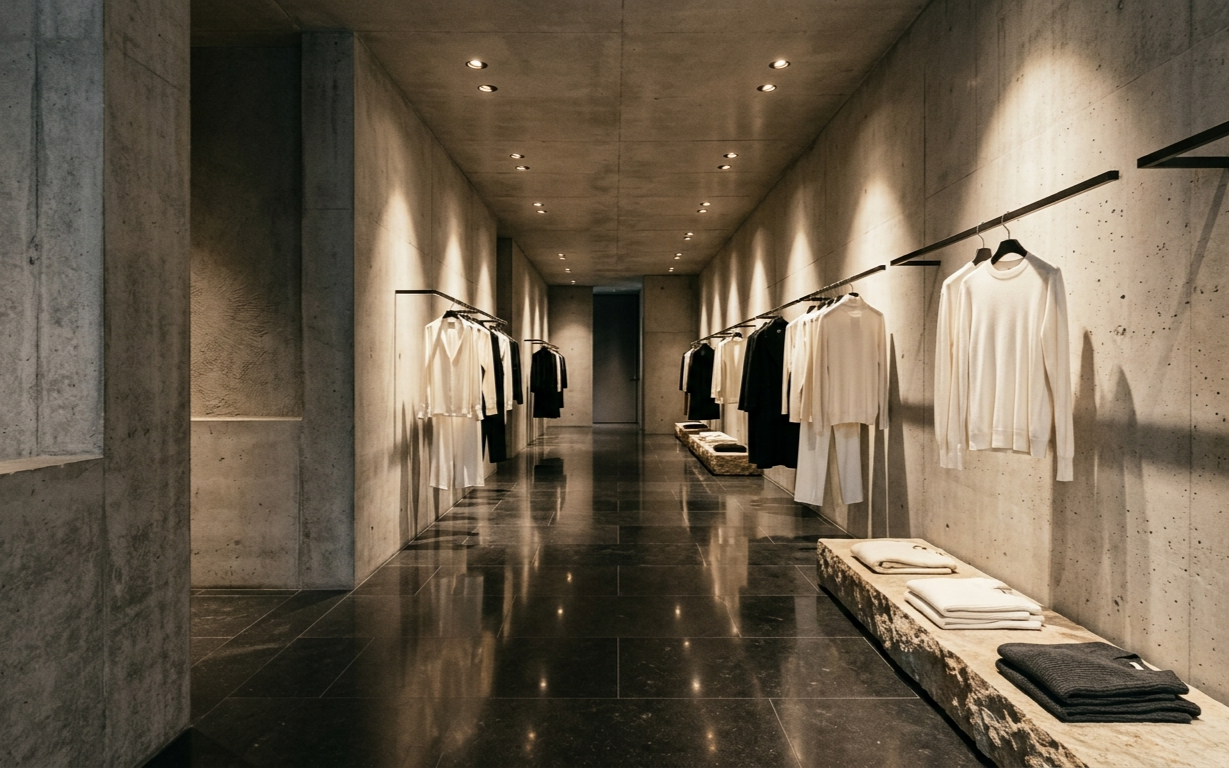
Visual merchandising is the ongoing editorial practice of the physical space. The fixture layout and the hero display at opening are the foundation; the weekly reinterpretation of that foundation keeps the space current and gives frequent visitors a reason to look again.
- Establish a visual merchandising guide that mirrors the brand's campaign language: same hierarchy, same restraint.
- Build in modular display systems that allow seasonal product stories to change without altering the architectural intent.
- Create a clear focal point at each zone transition — an image, a key product, a sculptural element — that directs the customer's gaze and movement.
Temporary and pop-up retail formats demand the same rigour as permanent stores, compressed into shorter timelines and smaller budgets. The constraint forces clarity: identify the single strongest thing the brand can say in that space and build everything around it. A 20-square-metre pop-up with one clear idea will always outperform a larger space with five competing messages.
- Brief the team on the spatial narrative before deciding on fixtures or finishes.
- Allocate at least a third of the budget to lighting — it transforms inexpensive materials and elevates product immediately.
- Document the installation in detail: a strong pop-up concept has long-term value as a visual reference and pitch asset.
The relationship between digital and physical retail has fundamentally changed the role of the store. Customers often arrive having already made a purchasing decision online — they come to confirm, to experience, and to be reassured. The store's job is now as much about brand reinforcement as product discovery.
- Design spaces that reward customers who already know the brand with depth: detail, craft, heritage.
- Create moments that do not translate to a screen — texture, scale, scent, sound — to justify the physical visit.
- Align the in-store visual language precisely with the e-commerce and campaign visual identity so no brand equity is lost in the transition.
- Use the store as a content creation environment: hero displays and installation moments that generate shareable imagery extend the space's reach beyond its four walls.
Staff behaviour is part of the retail experience design. The way a team member greets, guides, and informs a customer is as designed — or should be — as the fixture layout. Brief, train, and align staff on the brand's emotional promise, not just its product specifications.
For fashion brands entering new markets — opening a first flagship, launching a department store concession, or designing a trade fair booth — the spatial brief must be treated with the same strategic weight as a campaign brief. The store is the brand's most expensive and most permanent communication.
- Conduct a market context audit before the design process begins: understand what the local competitive landscape looks like and where white space exists.
- Calibrate the level of brand explanation to the market's familiarity with the brand — a first entry requires more context than a fifth-market expansion.
- Treat the opening period as a launch campaign: invest in the first impression as you would in a hero campaign image.
Retail experience design succeeds when customers leave having felt something they did not fully anticipate. Not surprise for its own sake, but the satisfaction of a world encountered at its most complete — where every surface, product, and moment of service confirms that the brand's promise is real.
That feeling is designed. It is the result of decisions made at every scale, from floor plan to lighting angle to the weight of a branded carrier bag. The discipline is total, the margin for inconsistency is narrow, and the reward for getting it right is a customer relationship that extends far beyond the purchase.