Temporary retail has moved from novelty to strategy. For luxury and premium fashion brands, pop-ups, installations, and short-term boutiques are now a structured way to test cities, collections, collaborations, and service models — without committing to a full lease before the market responds.
The risk is speed without system. A pop-up that looks like a generic white cube with product rails tells customers nothing about the house. The opportunity is to treat temporary space as a compressed brand statement: the same positioning, material language, and service standards as a permanent flagship, adapted to a shorter timeline and tighter footprint.
- What is this activation proving — market demand, category extension, or wholesale support in a key city?
- Does the spatial design reuse the brand's visual identity, or invent a one-off aesthetic that confuses recognition?
- Is staffing, storytelling, and product edit trained to the same standard as core retail?
- How will learnings feed back into e-commerce, wholesale decks, and future permanent locations?
European fashion houses often use Milan, Paris, or London as creative labs, then export spatial ideas to Dubai, Seoul, or New York. When pop-ups are documented as part of a retail system — not isolated events — they compound equity instead of fragmenting it.
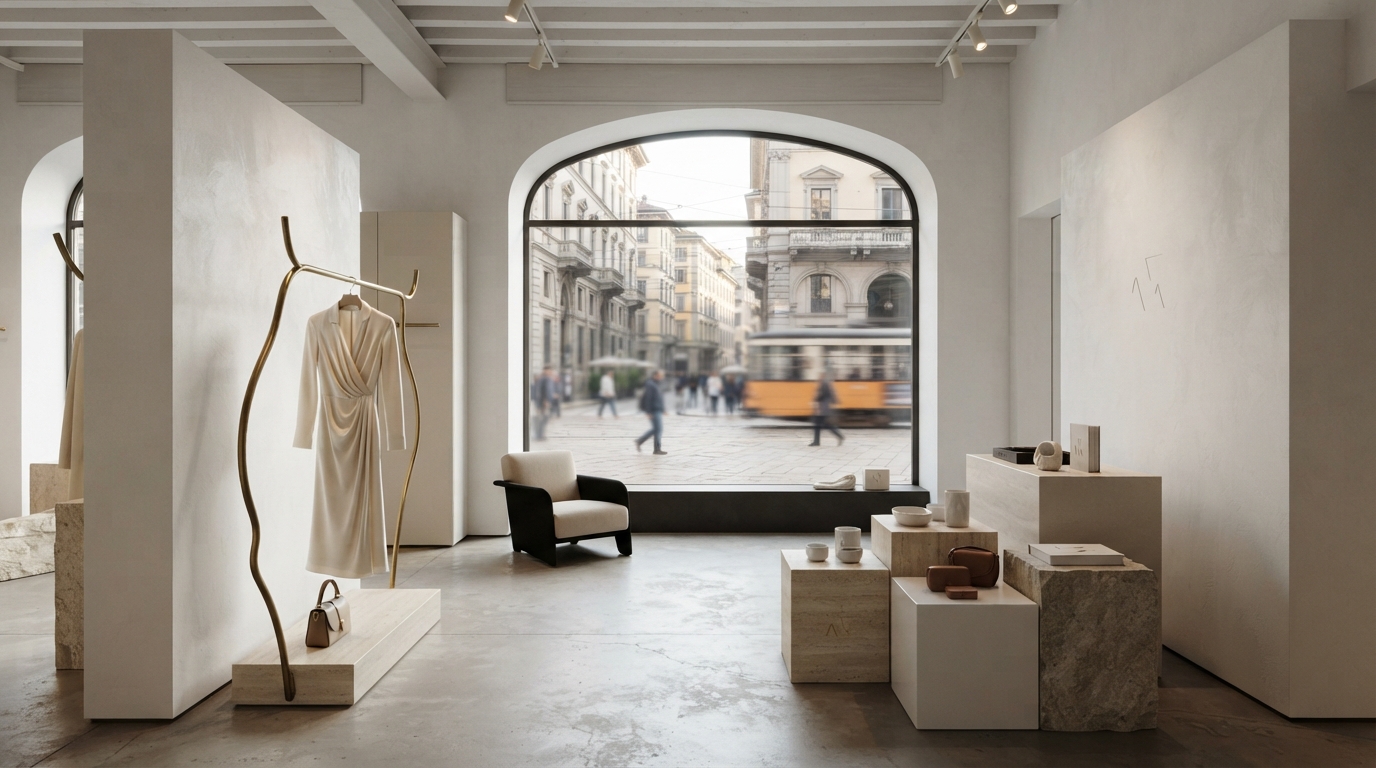
Strong temporary retail starts with a brief as rigorous as a seasonal campaign. Define audience, commercial goal, hero product story, and the three moments you want customers to remember: arrival, product discovery, and departure (including follow-up via digital or clienteling).
- Align pop-up concept with brand positioning before any venue or build partner is chosen.
- Design modular elements — lighting, display, signage — that can travel and adapt to different floor plates.
- Prioritise material truth and fit experience; temporary should not mean cheapened production values.
- Plan content capture on-site so the activation extends into social, press, and buyer presentations.
- Set KPIs beyond footfall: conversion, average transaction, data capture quality, and press or partner feedback.
Collaborations can amplify pop-ups when the partner's values align with yours. When they do not, co-branded spaces become the fastest way to blur customer understanding of what the core label stands for.
- Use temporary retail to debut categories or capsules with clear naming tied to the master brand.
- Keep typography, colour, and photography grammar consistent with campaigns running simultaneously online.
- Train teams on narrative — why this city, why now — so every interaction reinforces strategy.
Wholesale and travel retail add complexity. A pop-up supporting a key department store or a hotel partnership must feel owned by the fashion brand, not borrowed from the host's visual language. That balance is especially important for Italian labels expanding through selective distribution abroad.
- Negotiate visibility for brand identity within host environments — signage, digital, and staff uniforms.
- Bring the same product edit logic as direct retail; avoid dumping end-of-season inventory into temporary spaces.
- Synchronise launch dates with local PR, influencers, and buyer appointments where relevant.
- Document the build and customer flow for internal playbooks and future permanent store design.
Sustainability expectations are rising for temporary builds too. Reusable structures, rental furniture, and digital extensions that reduce printed waste are becoming part of premium perception — not a separate CSR slide.
The brands using pop-ups most effectively in 2026 treat them as research and storytelling tools, not clearance outlets. Each activation answers a question the leadership team actually has — and the answer informs the next season's retail, digital, and market plan.
- Run a post-mortem after every temporary space: what worked for brand, commerce, and community?
- Archive spatial assets so the next activation starts from a system, not from zero.
- Connect pop-up CRM data to e-commerce and clienteling with clear consent and service standards.
Temporary retail done with discipline can accelerate international growth and deepen local desire. Done without strategy, it becomes expensive noise. The difference is almost always preparation — not budget.
Planning a pop-up or temporary boutique that needs to feel unmistakably on-brand? Aleari supports fashion labels with spatial concept, visual merchandising direction, and retail experience design aligned to long-term strategy.